Tryfan: How hard is it (and are you ready?)
By Kate Worthington

Ask a child to draw a picture of a mountain and what will they usually depict? Steep, rocky sides and a pointy top, with maybe some big rocks around the summit. And, most likely, a triangular shape from base to sharp peak. Maybe even a solitary figure standing on the summit, arms aloft in celebration of the magnificence of the situation and surrounding vistas. Simple. That’s a mountain!
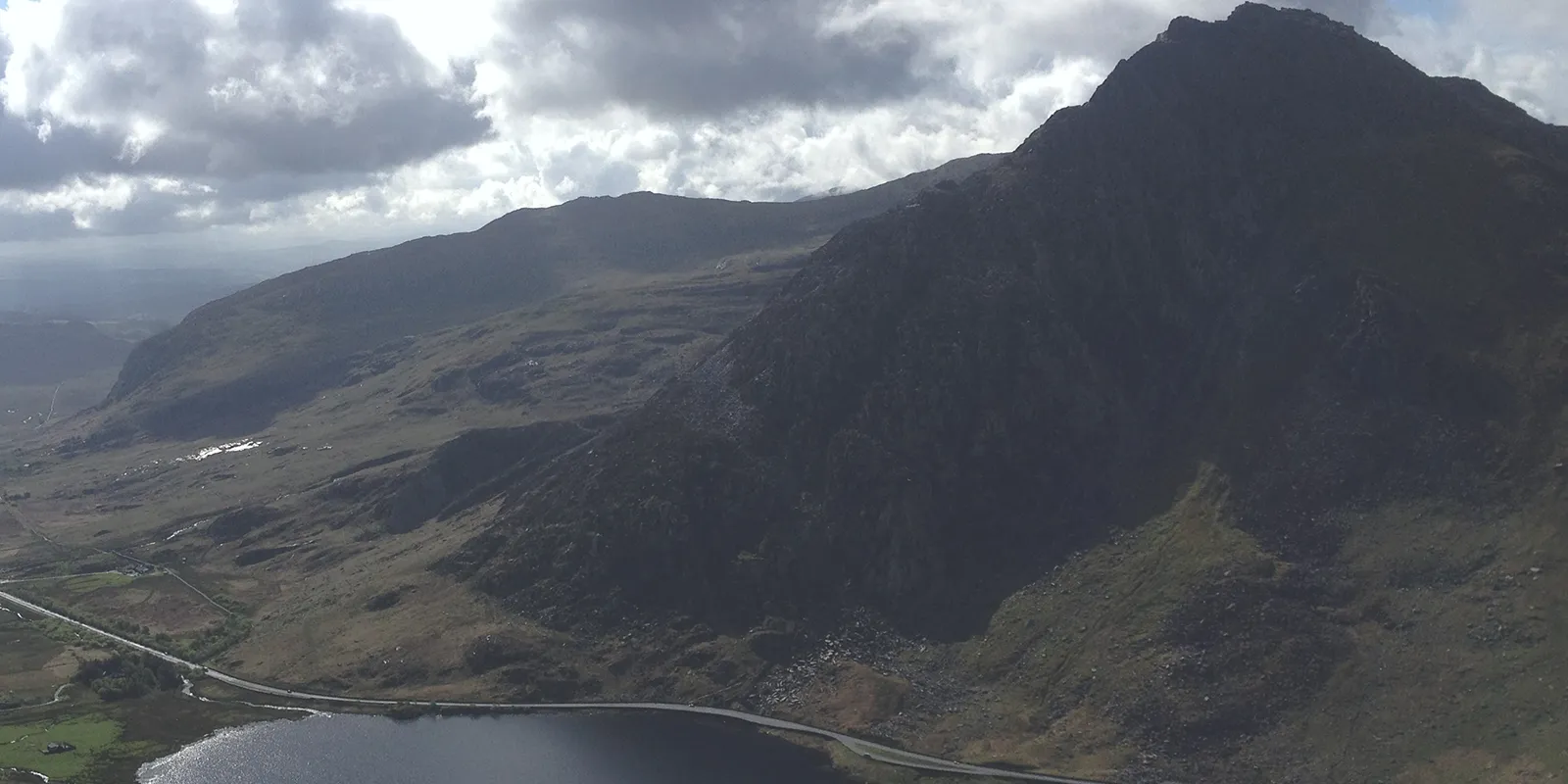
Well, that’s also Tryfan – a real-life mountain in Eryri National Park – quickly rising from the shores of Llyn Ogwen in the Ogwen valley. With its shapely, sharp, rocky character looming over the main A5 road, Tryfan quickly becomes an unmistakable landmark in this valley. There’s no hiding from view behind other summit ridges, or multiple cwms (valleys) and ‘false summits’ to ascend before reaching its highest point.
The final objective is seen from the road, and the only way is up, up, up from the road. This guide to Tryfan will help you plan and enjoy a route to its summit, but only if mountain conditions and personal experience suit.
What Makes Tryfan Unique?
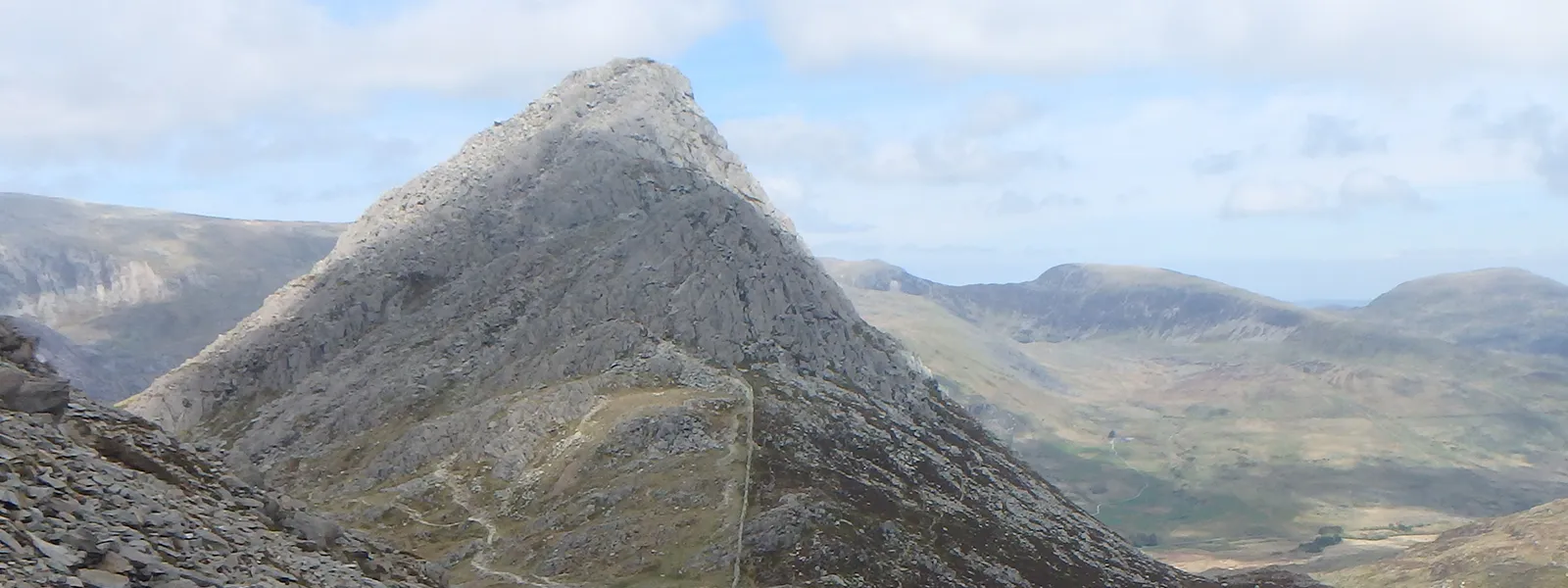
Tryfan is a very shapely, rocky mountain rising to a height of 917m (just over 3000ft). Its faces are described as the ‘North Ridge’, ‘South Ridge’, West Face’ and ‘East Face’…and that’s it! It’s pretty simple in terms of its shape; steep and rugged on all sides, except for its lower slopes – usually steep heather and bracken covered grass and broken rock.
From most aspects, Tryfan looks like the humped back of a dinosaur – maybe a Stegosaurus – with its plate-like spikes on its spine. Tryfan is very characterful and photogenic, and initially doesn’t look as high as it is – this will explain some of its popularity! Tryfan is composed of very hard, volcanic rocks which have been able to withstand erosion processes over geological time – over 450 million years.
The nature of the terrain on Tryfan means that a ‘walking route’ will always involve a degree of complex route choice through rocky terrain, including ‘scrambling’ moves to ascend through various steps and rocky clefts, and over large boulders. Hence, routes on Tryfan do not offer beginner walking routes with linear paths or simple navigation.
Based on this level of challenge and the dramatic nature of the terrain, the mountain earns a reputation for being an exciting and worthy goal for those seeking adventurous walking and scrambling experiences. Does this reputation actually increase attention, rather than put people off? Quite possibly, yes. Which is why it’s increasingly important to understand what planning a walk on Tryfan entails…and why there is not much ‘walking’ to be had!
What to Expect
There are a number of routes available for walkers to ascend Tryfan. And there are many more routes for climbers and mountaineers to reach its summit. Even the ‘walking’ routes will involve having to route-find through steep areas of loose and jumbled rocks, steep steps and passing by exposed sections and across the top of steep gullies. Hands will be needed for simple climbing moves between rock steps and there is no engineered or clear path to follow once above any vegetation.
This environment creates a stark difference between Tryfan and other mountains in the area. Even though nearby mountains have very rocky and technical aspects to them, there are more suitable tracks and paths for standard walking. On Tryfan, this is not the case! And this is what walkers will notice immediately; Tryfan does not offer a typical ‘mountain walk’ experience.
Whilst this experience offers rewarding challenge and adventure, many first-time walkers will be surprised by how tricky route-finding can be, and how easy it is to lose the most efficient and secure route through the rocky terrain. For ‘walkers’, the most popular routes to the summit are via the North and South Ridges, with the North Ridge offering a longer and more complex journey to the summit, via many rocky ledges, clefts, gullies and boulders.
Planning Your Visit
If you’re thinking of Tryfan as a mountain walk objective, note these key planning considerations to ensure your experience is a positive one.
1. Firstly, think carefully about your current experience (and that of anyone else you’re with, including dogs!) and if your mountain walking experience gives the skills and confidence to route find in more complex, rocky terrain. There isn’t a clear path to follow, and reliance on following ‘trails’ on a GPX device or phone can cause confusion as to where to go. If you need to rely on a mapped trail to follow, rather than having the skills and confidence to work out where to go yourself, maybe Tryfan isn’t the right objective for you this time.
2. Think about the current and forecasted weather and what the weather will feel like when you’re higher up the mountain (colder, stronger winds). Some rocks are very slippery when wet and poor visibility in clouds can be very disorientating when trying to route find amongst large rocks.
3. As with any mountain walk, pack extra warm and waterproof layers, gloves/hat, extra food and drink, a way of navigating/route finding on the hill (ideally a clear map you can read and a way of confirming your location and what direction you need to travel in if the visibility is poor – can you read a compass, for example?)
Common planning mistakes include underestimating the time it can take to reach the summit (and descend again), setting off too late in the day or in poor weather that gets worse during the day/the higher you climb.
Starting your walk early in the day, with a dry/low wind/good visibility weather forecast – with plenty of knowledge about the route and some experience in route finding in rocky terrain already, will increase chances of enjoyment and success.
Increase your confidence with a Mountain Skills Course
Delivered by RAW’s qualified trainers and designed by awarding body Mountain Training, Mountain Skills is ideal for anyone wanting to extend their hill-walking experience to more challenging mountainous areas.
Things to Know Before You Go
Tryfan is, understandably, an alluring objective for anyone who’s drawn to mountains and adventure. Its prominent shape and steep aspects will appeal strongly to those who enjoy a physical challenge surrounded by dramatic, rocky terrain. And because Tryfan’s striking silhouette is so visible from the A5 road below – and the summit is visible from certain angles – it looks very ‘accessible’ in terms of time and effort. This is a major misconception!
Remember that there’s also not very much ‘walking’ to be had on Tryfan – much of the ascent will involve scrambling through rocks and gullies. This type of ascent can be hugely rewarding, and the more experience walkers have in similar terrain, the ascent and route finding will feel less challenging.
Is Tryfan a suitable objective for first-time walkers? This is a popular question. If someone is very new to mountain walking or hasn’t been out on rocky and technical ground before, then it could be argued that Tryfan would not be the best choice for a first-time summit. But, what about joining a guided group to learn more about the mountain, its routes and the differences between ‘walking’ and ‘scrambling’?
Many outdoor activity providers (including Climb Snowdon) in Eryri will be able to advise accordingly. The most reliable sources of information to find out more about Tryfan will be from reputable guide books (ask in a local outdoor shop or book shop for recommendations), online guides and blogs. There’s only a limited amount of information that can be gained through photos and stories on social media; even though the imagery of the mountain can be very enticing!
Final thoughts
Tryfan is a worthy objective for an adventurous day out in the mountains of Eryri. Its commanding position overlooking Llyn Ogwen is magnificent, with a beguiling appeal for mountain lovers. With careful forward planning and consideration, an outing on Tryfan can be possible for those with good mountain fitness, some walking and scrambling experience and confidence in route finding and navigating in mountainous terrain.
But, for those new to mountain walking and/or scrambling in steeper terrain, a day out on Tryfan could be an objective for the future and/or provide inspiration for joining a guided day’s mountain journey with a professional instructor, to learn more about scrambling and planning for technical mountain routes.
Tryfan is worth investing some extra time and effort to gain its summit; it’s not an easy mountain walk – but with due care and consideration, reaching the summit is a well-deserved achievement. Speak to our friendly team about making it a reality for you with a 1:1 guided climb or private group experience.
Explore More
Categories
More Guides & News
Crib Goch: Our Guide to Snowdon’s Most Iconic Ridge
The ridge of Crib Goch has become a symbol of exhilarating mountain drama; providing the perfect environment for historical alpine and high-altitude training. This detailed guide will help that planning process by covering topics including route choice, what to expect, kit required and how weather forecasts will help to make decisions for yourself and anyone you’re with.

Six Routes. One Mountain
Designed and delivered exclusively by RAW Adventures, the Snowdon 6 Challenge invites you to explore six of the mountain’s most iconic routes – all in one incredible, fully-supported day. And now, thanks to our charity partner The Joshua Tree, you’ve got a rare opportunity to be part of something even more meaningful…

Hot Dogs on the Hills: Keeping Your Canine Safe in the Mountains This Summer
There’s nothing quite like heading into the hills with your dog bounding beside you – ears flapping, nose to the ground, tail wagging. But when the sun is blazing and temperatures rise, our mountain-loving companions need a little extra care.