Crib Goch: Our Guide to Snowdon’s Most Iconic Ridge
By Kate Worthington

The ridge of Crib Goch has become a symbol of exhilarating mountain drama; providing the perfect environment for historical alpine and high-altitude training. For anyone with regular mountain walking experience and fitness, this beautifully curvaceous route offers an unrivalled parade over northern Eryri’s most iconic mountain terrain: Crib Goch, Garnedd Ugain and on to Yr Wyddfa (Snowdon) – three of the fifteen peaks in Eryri that rise above 3,000ft.
Prior scrambling experience and confidence over exposed and steep rock will increase enjoyment of this route, which traces the unmistakable, sweeping skyline of Yr Wyddfa, as seen from the north-east of the massif. Planning and patience will be rewarded; this journey demands to be enjoyed to the maximum. Waiting for your plans, stable weather and mountain conditions to align will be worth it.
Due to the steepness of some of the rocky steps (needing hands to help), the exposure and the sustained length of this terrain, the ridge is described as a Grade 1 scramble (the highest grade being 3 in ‘scrambling’ terms). With its airy atmosphere and considerable exposure on each side, the ascent is not a straightforward walking route and planning to ascend its slopes should weigh up various decision-making factors.
This detailed guide will help that planning process by covering topics including route choice, what to expect, kit required and how weather forecasts will help to make decisions for yourself and anyone you’re with.
What is Crib Goch?
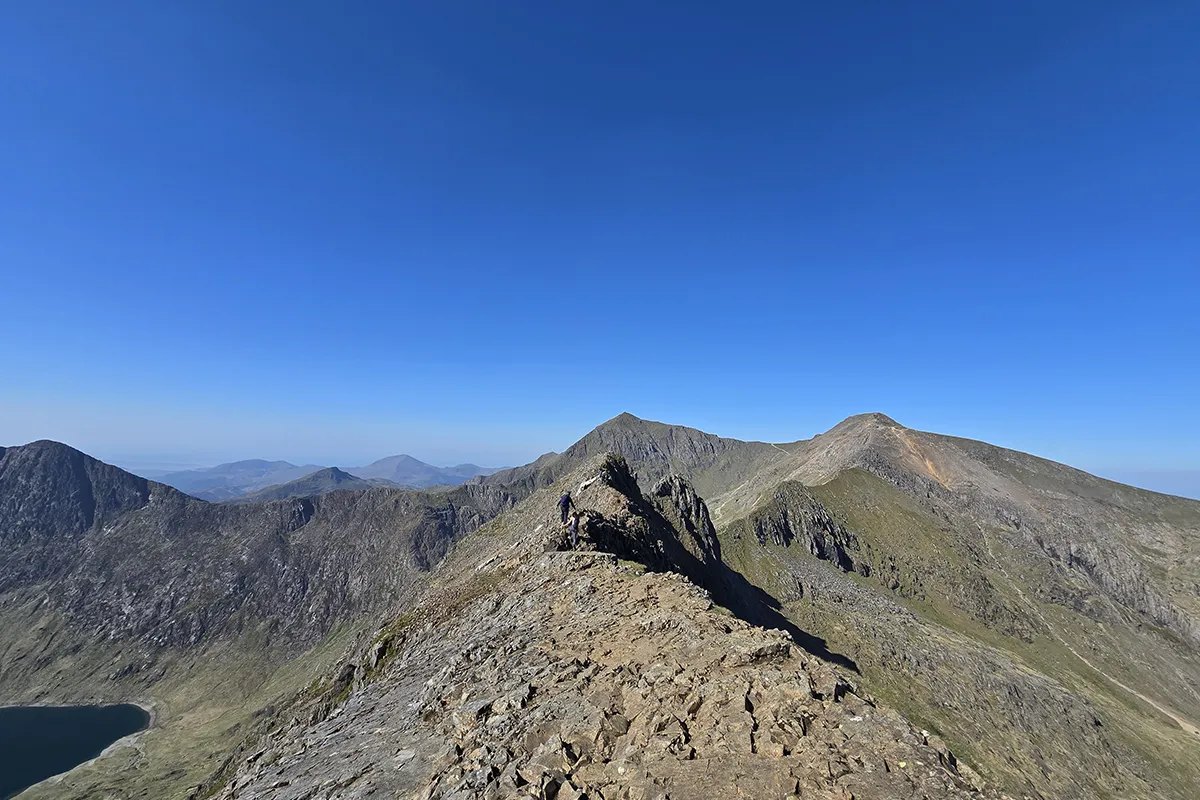
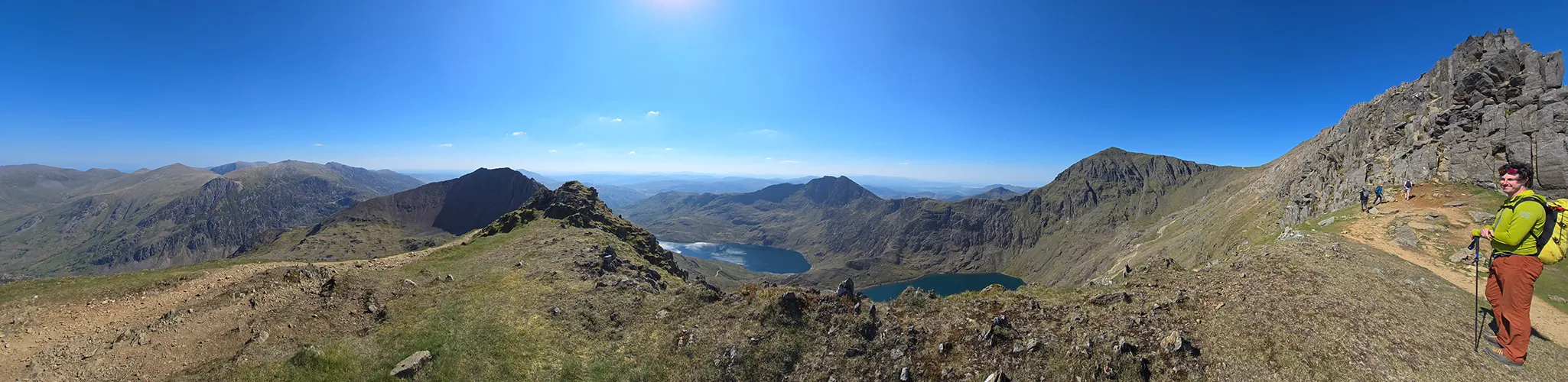
The ridge of Crib Goch is a narrow ‘arete’ of rock that forms a hard boundary between two shallow cwms (valleys) either side – which hold the waters of Llyn Llydaw to the south and the smaller Llyn Glas to the north.
These cwms would have been carved out by glaciers, as they slid away in different directions, from the harder rock of the arete in the middle, when the whole area underwent massive erosion and change during the last ice age, apx 10,000 years ago.
Melting ice sheets, snow and ice left thick glaciers at higher altitudes, whose movement and erosion created the familiar shapes we recognise today.
And subsequent freeze-thaw cycles of water in the rocks have affected exposed mountain summits and ridges, where rock has become jagged and eroded over time.
The remaining exposed ridge of Crib Goch forms one side of the well-known ‘horseshoe’ shape of Yr Wyddfa, and its ridge-line is mirrored slightly by Y Lliwedd, a slender and steep summit on the other side of Llyn Llydaw.
Crib Goch is a beautifully descriptive Welsh name meaning ‘red ridge’. The pink and red hues of the rock are most notable when early or late sun hits the bare, rocky, slopes. At these times of day, the low sunlight hitting the mountain is further away and passes through increased layers of dust, which causes wavelengths of light to behave differently. Only longer wavelengths of light pass through the increased dust and we see this is red/pink/orange light. And the combination of this effect, plus the tiny particles of iron deposits in the volcanic rocks of Crib Goch, means the whole ridge can glow – amazing!
Just How Hard is Crib Goch?
“Those who ‘tackle’ Crib Goch are intrepid and brave…
…it’s a ridge to be scared of and it should only be climbed by mountaineers and experts”.
Looking at dramatic photos of Crib Goch, or even watching film footage from people on the ridge, you can see how and why Crib Goch has earned a somewhat ‘infamous’ reputation. Some of these misconceptions contain a lot of truth, and some of these stories are told and re-told until we think they are the absolute truth.
The ridge speaks a thousand words itself; you can’t deny that its slopes are very steep and, from certain locations, a trip or fall would have VERY serious consequences – absolutely. Crib Goch is a ridge line to be respectful of, and being fully aware of its hazards and risks is the best place to start when planning a route to include this section of Yr Wyddfa’s massif.
There are many other, more straightforward, paths that lead to Yr Wyddfa’s various summit points. And for certain groups of walkers, and/or in particular weather conditions (notably windy and/or very wet conditions), these other paths should be the ONLY route choice.
On a no rain, no or low-wind day (less than 20mph is comfortable) – with good visibility and dry rock – an experienced and confident mountain walker could really enjoy a walk and scramble up Crib Goch’s east ridge and along its crest, experiencing the stunning views from the ridge itself.
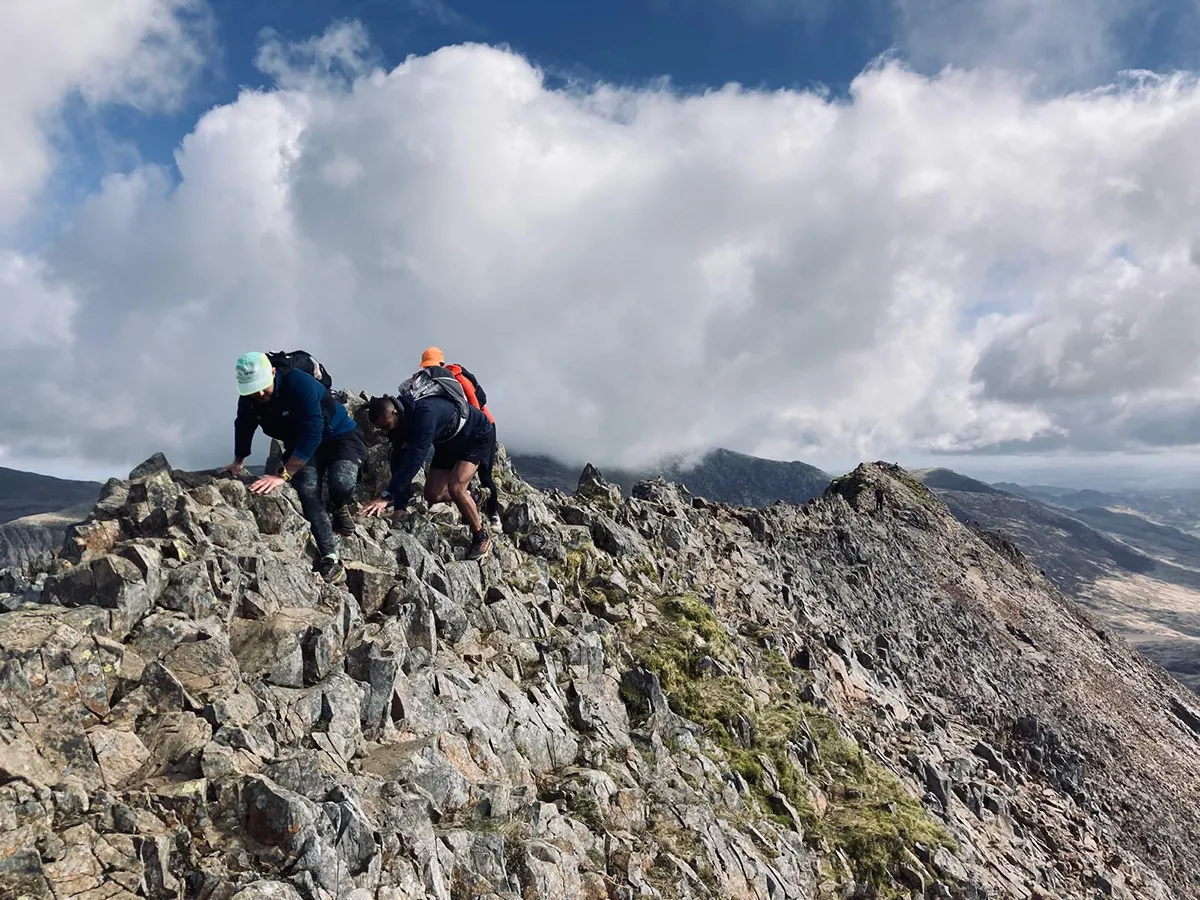
Walkers would also really benefit from some previous experience on similar rocky ground, increasing confidence with how to move legs and arms to maintain balance whilst walking on uneven rock, or climbing simple rocky steps. This is ‘scrambling’, rather than walking – where hands are used and simple rock climbing techniques will aid ascent.
Crib Goch offers multiple opportunities for confident and experienced walkers to enjoy this progression to ‘Grade 1 scrambling’. This term was used most consistently by the author, Steve Ashton, who wrote a guidebook about scrambling in Eryri in 1980
Thinking about these aspects of the ridge, we can think of Crib Goch as a challenging ridge – both physically and mentally. For some, the exposure and anxiety felt can be more overwhelming than the physical challenge. And the long ascent from Pen y Pass, via Crib Goch’s east ridge (even before the narrow summit ridge is reached) poses its own difficulties for those who are not used to steep, rocky paths.
Muscular strength and fitness helps to guard against ‘wobbly legs’ (more noticeable if muscles are fatigued) which can increase feelings of insecurity when on steeper sections of the route.
“I went in with zero scrambling experience and terrified of the prospect of Crib Goch, which had been quite prohibitively mythologised in my head via social media etc as an impossibly scary ridge line.
Thanks to RAW’s organisation, proper assessment of our individual abilities, and more than adequate supervision by guides with world-beating CVs, I managed to achieve something that I thought was meant for other people, not me… I’m beyond grateful excited to now feel able to continue building confidence in these truly awe inspiring environments; spaces that before the weekend with RAW I thought just weren’t meant for me.
Ben – April 2026
Guided Crib Goch
Where Does the Crib Goch Route Start?
A very logical start point for an ascent of Crib Goch starts from Pen y Pass, at the highest point of the Llanberis Pass and A4086 road. Here there is a small car park, a hostel (YHA Snowdon Pen y Pass) and a Warden Office for Eryri National Park.
Access to Pen y Pass can be gained by the Sherpa’r Wyddfa public bus service from Nant Peris Park and Ride car park, which is far easier and cheaper than relying on parking at the very small and busy car park at Pen y Pass itself. In summer months, there’s a bus service from Nant Peris Park and Ride car park apx every 15 minutes.
The initial ascent of Crib Goch will follow the well-used Pyg Track for the first 45 mins or so, until a junction of routes is reached at Bwlch y Moch. Here, walkers can either carry straight on, over stiles, to continue on the Pyg Track (advisable when the weather is not conducive for an ascent of Crib Goch or there’s any uncertainty for your/your group at this point).
To gain the lower slopes of Crib Goch’s east ridge, walkers need to make a deliberate turn off the Pyg Track, behind a stone wall to find the continuation of a route towards the bottom of the east ridge.
When viewed from the ‘pass’ of Bwlch y Moch, the east ridge of Crib Goch can sometimes be mistaken for the summit of Yr Wyddfa itself. The east ridge is the pyramidal shape spur seen from the Pyg Track and the steepest section is visible as a rocky band that seems to cut across the ridge, about half way up.
From Bwlch y Moch, the way through this steep, rocky band doesn’t look obvious, but this is because you can only see the vertical faces of rock from this angle, and not all the flatter sections that give respite between these steeper rock steps. It can take at least an hour, sometimes more, to gain the height of this part of Crib Goch. And that time does not include crossing the narrow summit ridge beyond. This dramatic section is yet to come…

“Connor our guide from RAW was fantastic leading us up and over Crib Goch and the Snowdon skyline.
He was very skillful and knowledgeable with a great personality and encouraged us all. I would recommend and will use again”.
Andy – August 2025
Guided Crib Goch
The Ridge: What to Expect
Once you’ve left the Pyg Track route at Bwlch y Moch, the first part of Crib Goch’s ascent is straightforward on a rocky path, turning increasingly loose underfoot as it zig zags and gains height towards the main, steep rock band half way up the east ridge.
Making progress up this lower path involves climbing through some short sections of scrambling, which gives a good opportunity to get used to using hands, as well as well-balanced foot steps, to keep steady through steeper slabs of rock.
Throughout this ascent, the ground underfoot will become increasingly more rocky, from engineered pitched path slabs, to looser rock on an eroded path and then large slabs of bedrock that provide steps to climb. Some of these slabs and steps of rock are quite ‘shiny’ from so much erosion of feet, and can feel smoother and slippery in wet weather.
The most secure route ascending the east ridge actually keeps to the steepest, solid bed rock on the crest of the ridge. Even though the ‘sides’ of the ridge can look less steep – they are actually looser and more vegetated, and do not provide a secure route. Avoid them.
Half way up the east ridge, the route zig zags through a steep, rocky band of rock – where the most challenging and exposed rock step on the east ridge is found. The scrambling required to move through this is simple, using foot and hand holds to logically climb, but some people feel uneasy about this change of angle. It feels steep. For anyone who is now feeling unsure about continuing, this moment is when to turn around and descend. Once you have moved through this steep rock band, it’s very tricky to turn around and down-climb through this section.
Once through this rocky band, it will take at least another 30 mins to reach the top of the east ridge, where there is ample space to sit and rest before carrying along the narrowest section of the ridge…which is what you came for!
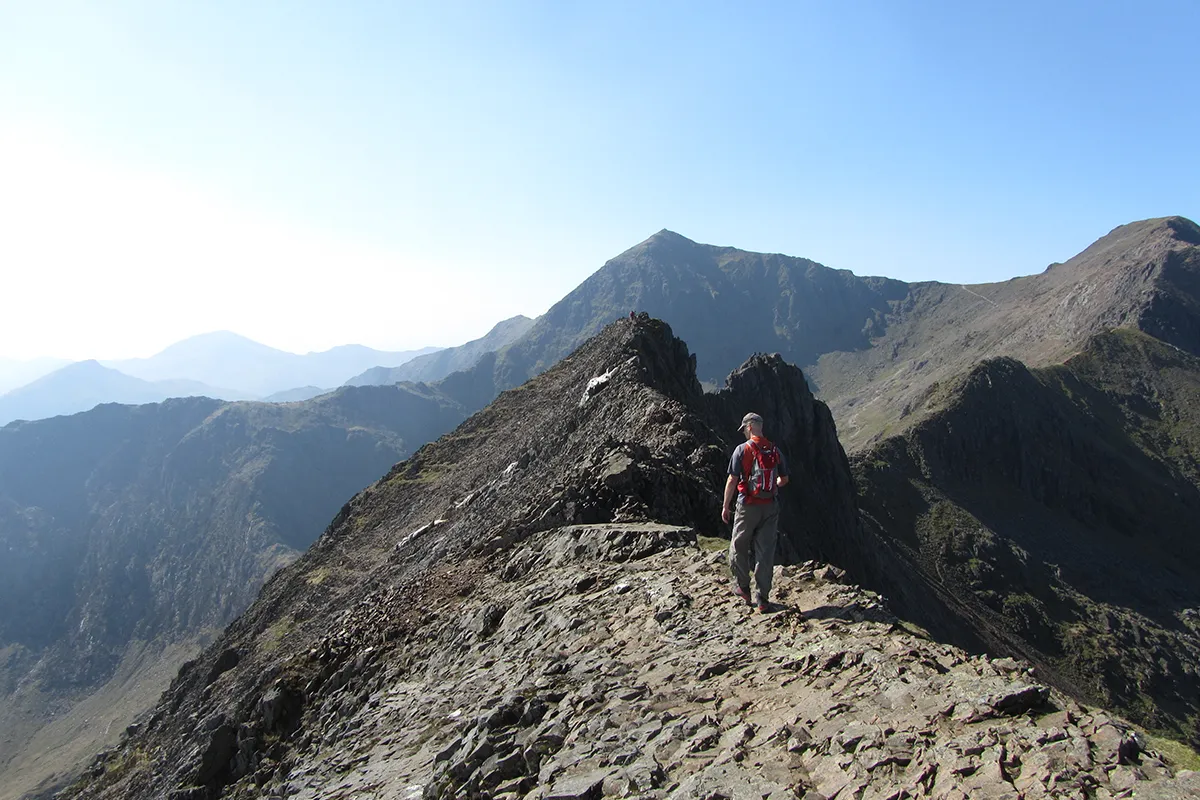
Ahead of you now is Crib Goch’s summit at 923m and the next 400m will need good concentration and balance to keep steady as you progress along the very narrow arete.
Think of the very top of the ridge like a bannister and take a couple of steps down to the left, so you can keep in contact with the rocks, with your right hand – sometimes both hands as needed. It can take up to 30mins to cross this very short section, especially if you need time to pause at various moments to rest and take in the amazing views!
Always make sure you’re well balanced on larger areas of rock when you want to stop. If others on the ridge want to pass by, let them make their own way round, whilst you stay in a position you’re happy with. Smile. Be proud of yourself for being here!
After this narrowest section, the ridge widens slightly at the summit area and then approaches three pinnacles of rock. The first two pinnacles can be bypassed to the left if desired (the more technical scrambling over these two pinnacles offers greater exposure for experienced scramblers). The third and final pinnacle has to be crossed, and the route offers a number of large steps that are more conducive for everyone to climb, and then descend the other side.
Walkers unfamiliar with this particular route or type of terrain usually find that the time taken to ascend the east ridge, even before reaching the narrow ridge traverse, is the most surprising aspect. There is a lot of route finding and scrambling sections to move through, which can take up a lot of energy and time, especially if people are not used to scrambling or mountain walking generally.
Is Crib Goch Dangerous?
The shape of Crib Goch itself, with its impressively steep sides, means there’s no easy route to descend, other than continuing along its full ridgeline towards Garnedd Ugain and to Yr Wyddfa’s summit area. This makes the route very committing; meaning there’s no secure or safe way to descend once you’ve climbed through the steep band of rock half way up the east ridge.
Hazards such as loose rock, steep or vertical areas of rock, eroded and smooth sections of rock slabs and areas where route finding through more complex areas of rock can be confusing, make this ascent mentally and physically demanding.
For this reason, if you’re planning a route that includes Crib Goch there are a number of planning decisions to factor in (more so than when planning to ascend other routes on Yr Wyddfa).
Questions to run through before thinking about approaching Crib Goch need to include:
- Do I (and the group I’m with) all have enough experience and fitness to complete this route without difficulty?
- Does everyone have experience of being on exposed rock and do we know how exposure might affect us?
- Am I familiar with the route, or can I route-find confidently based on my experience, without having to follow others?
- Do I have enough time in the day to complete the route without worrying about how long it might take?
- What is the weather forecast telling me about the day? Can I interpret the weather forecast and how it will affect me on the ridge?
- Do we all have enough extra clothing/kit and food/drink that means we can make progress comfortably over time, in the forecasted weather?
- What plan is there if someone/you are not happy with the route on the way up? Who will make the decision to turn back around early on, if necessary?
One of the key planning decisions for an ascent of Crib Goch focuses on the forecasted wind speeds for the day… at summit level. Wind speeds will be higher at 800-900m than when standing at Pen y Pass, so it’s essential to find out what wind speeds are at summit level from a mountain weather forecast (check the Eryri National Park forecast from www.mwis.org).
If the speeds are forecast at above 25mph, then alarm bells need to start ringing to ensure you, and people you’re with, are experienced enough to know what these wind speeds will feel like on more exposed ground. For example, winds of 30mph+ will be enough to affect balance and progress, and could increase anxiety for some people. Rain and wet rock are also hazards worth noting, as some of the rock on the ridge feels very smooth underfoot when wet and being exposed to rain and wind on a very narrow ridge increases hazard for all.
There are very serious consequences to a slip, trip or fall on Crib Goch, due to the steep slopes on either side in many locations. Quick escapes can be impossible from most of the ridge and it is worth noting that, very sadly, there have been deaths on this ridge due to slips and falls.
For the number of people that ascend Crib Goch each year (apx 25-30,000) the number of fatal accidents stands at apx 1-3 in a year. The unthinkable can and does happen, which is why it’s imperative for anyone planning an ascent of Crib Goch to accurately assess their own experience against the planning factors above and consider their own safety.
What Kit Will I Need?
When planning for any mountain walk, there are a number of essential items that will increase your comfort and safety, especially for a committing and exposed route like an ascent of Crib Goch.
Think about principles of comfort and protection, rather than worrying about the latest designs and expensive materials.
What to wear
- Use a synthetic ‘base layer’ which can be layered with a thin or thicker synthetic fleece/warm layer depending on temperatures.
- Avoid denim jeans for walking trousers, but look for a comfortable, synthetic walking trouser or stretchy, synthetic leggings, which will stretch when scrambling.
- Protect arms and neck in very sunny weather; a long sleeve base layer is more cooling/protective than a vest top.
- Outer jackets will need to be windproof or water-resistant on dry and/or windy days, with an extra waterproof jacket always carried, in case of rain or colder temperatures.
- Layering a few thinner layers is more flexible than wearing a thick jacket, as you’ll experience a difference in temperature as you ascend the east ridge.
Footwear
- For more experienced walkers, a pair of specific ‘trail/off-road’ trainers with an aggressive sole grip may be enough to offer support and comfort on dry rock.
- Avoid ‘flat soled’ trainers that don’t offer adequate grip on rock or in damp conditions.
- Walking boots offer a good amount of ankle support and excellent sole grip for some walkers, but get used to wearing a new pair before a long day out.
- One pair of synthetic, thick socks should provide enough comfort and protection for feet.
What to pack
- Take a small rucksack packed with an extra, warm/fleece layer, a pair of warm gloves and hat, a zipped, waterproof jacket with large hood and waterproof trousers that can pull over your walking trousers/leggings.
- Add to this rucksack your food, drink, navigation aids/map, extra warm layers, phone charger and a waterproof bag to keep this all in, as most rucksacks are not fully waterproof on a very wet day.
- A head torch (and spare batteries), based on time of year/time of day you’re planning to walk
- A small ‘First Aid’ kit with some plasters, pain relief, suncream and personal medication and an emergency ‘group shelter’ that can be used to sit on for family lunch breaks, give some overhead shelter when taking a break or provide emergency shelter for an unforeseen situation/injury, for either one person or a number of people.
When packing your kit, ask yourself, “Can I remain comfortable, warm and dry even if I’m walking much slower than planned or stopped completely – in a variety of weather and mountain conditions?”
When’s the Best Time to Climb Crib Goch?
Undoubtedly, the best time to ascend Crib Goch is on a day that is dry (and forecasted to stay dry), with high cloud base and good visibility, low winds (less than 20mph) and a moderate air temperature. You want everything to feel ‘comfortable’ when you’re working your hardest on the ascent and across the narrow section of Crib Goch.
Early summer (May/June) can be less busy than July/August in summer holidays and Mon-Thurs are quieter than weekends, obviously.
Sundays are quieter than Saturdays in the busy summer season. Sometimes, early mornings in summer can provide quieter periods, before the busier times of 10am onwards on the mountain.
Bank Holiday weekends are notoriously busy, and a high amount of people on the ridge can result in having to stop and wait at certain sections, as groups take their time to move through various rock steps. Patience is required on busier days.
Unless you are very familiar with the route and mountain walking/scrambling in general, plan to completely avoid hours of darkness or short days in late autumn or winter, when the weather can be less reliable and temperatures/wind are much colder, with frost and ice present on the mountains, if not snow at times.
Only experienced mountaineers should be planning for ascents in winter time, when there is a lack of daylight hours and increased hazard of colder temperatures, rain or snow and higher wind speeds. Snow can fall on the mountains well into late March and April sometimes, so it’s always worth checking daily weather forecasts and asking locally for advice on mountain conditions before planning a walk.
“I had the absolute pleasure of doing the Crib Goch Horseshoe with John, and I can honestly say the whole experience was incredible. It was just the two of us, and from start to finish, he made me feel safe, supported, and totally at ease. His calm, friendly nature made it feel more like hiking with a knowledgeable friend than anything else. Crib Goch can be an intimidating route, but John guided with quiet confidence—never pushy, always encouraging. He let me take the lead when I wanted, offered reassurance on trickier sections, and was just really easy to talk to throughout. His passion for the mountains really shone through. I couldn’t have asked for a better guide or a better day. If you’re considering this route and want someone who genuinely cares and knows their stuff, I’d recommend John in a heartbeat”.
Tania – May 2025
Guided Crib Goch
Common Mistakes First-Time Crib Gochians Make
It’s very easy to find information and footage about Crib Goch across a range of platforms including guide books, online information, blogs and all forms of social media. Many alluring photos of the dramatic ridge line on social media draw walkers who want to see and feel the same; but some of these walkers will not have any previous scrambling or mountain experience to draw from, so it’s hard for them to imagine what experience they might have.
Underestimation is a key factor here – whether that be underestimating the technicality of the terrain, the exposure felt on the steepest sections, the time it takes to ascend and cross the ridge and how much higher winds and wet weather can affect progress.
Without prior experience of Crib Goch, or similar routes, it’s challenging to predict moving time and speed, which can result in some groups setting off too late or not factoring in timings of weather changes during the day and how this may affect them on the ridge.
Other mistakes that can occur, through inexperience and planning errors, include following other people without questioning where they’re going or not taking into account weather forecasts.
Also, based on human factors such as ‘social peer pressure’ and ‘herd mentality’, it’s very easy to get sucked along with a decision made by someone else, and then when people are feeling too nervous to carry on they find themselves in an area that is difficult or impossible to turn back from. This outcome can result in calls to Mountain Rescue services – where there is no injury, but people have become ‘stuck’ and unable to move back or forward.
Alternatives to Crib Goch
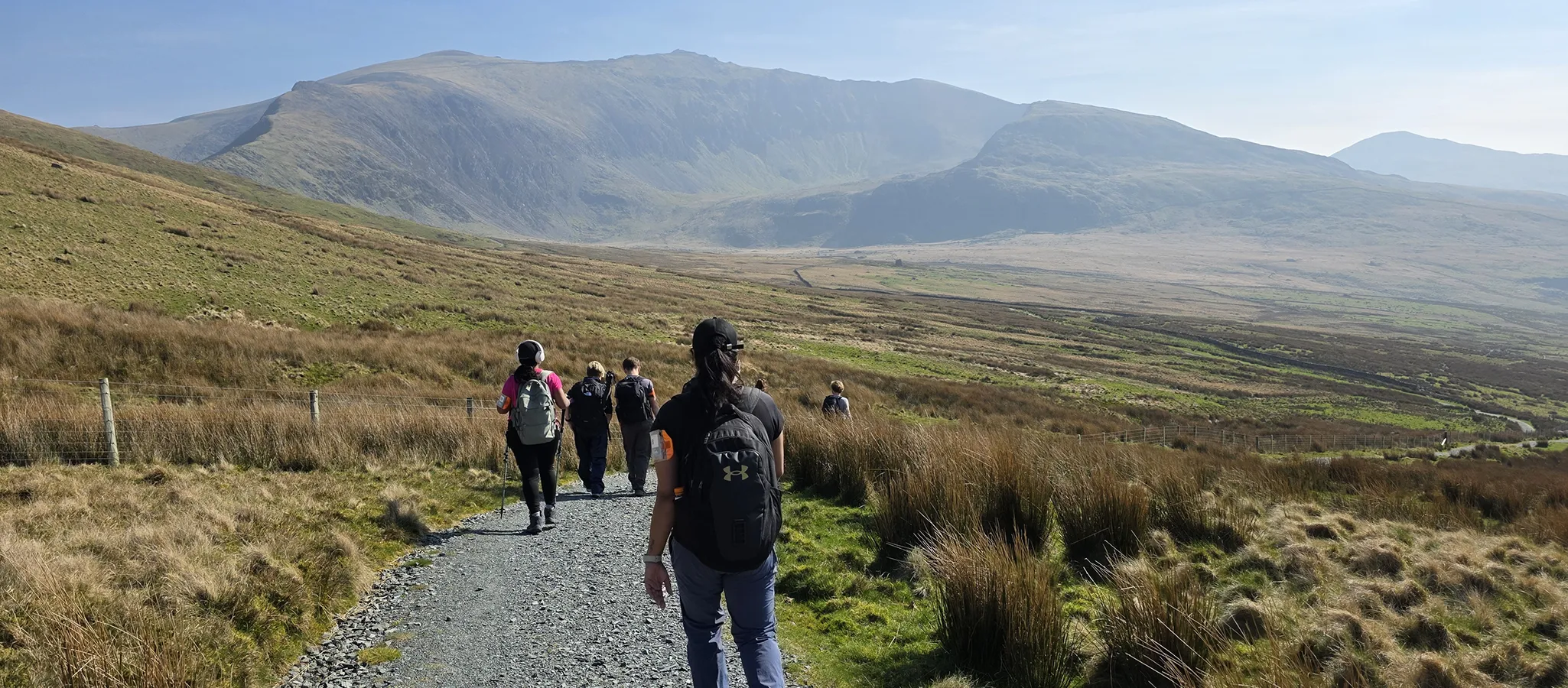
If you’ve discounted an ascent of Crib Goch based on planning factors such as the weather forecast or personal/group experience then you still have plenty of choice of adventurous routes to create a full mountain day.
For walkers with previous mountain walking experience, making a round trip to Yr Wyddfa’s summit via the Rhyd Ddu path up and the Snowdon Ranger path down (using Public Footpaths to cut across lower ground back towards your Rhyd Ddu National Park car park starting point) creates a challenging and less-travelled circuit to enjoy.
Similarly, an alternative route for those with good fitness makes a round trip from Bethania National Park car park, using the Watkin Path in ascent and the Rhyd Ddu path in descent, until Bwlch Cwm Llan (‘the pass of Cwm Llan’) is reached, where a descent back to Bethania in Nant Gwynant is taken, through the impressive bowl of Cwm Llan.
On windy days, using the Pyg Track in ascent can provide some shelter from the usual prevailing SW winds, up until the summit ridge of Yr Wyddfa is reached. Once on this final ridge, the walk up to the summit IS very exposed to wind and rain, so everyone in your group needs to be sure you’re happy to continue to the summit.
Note that in windy conditions, the Snowdon Mountain Railway trains sometimes cancel their services to the summit visitor centre, which means the station and cafe remain closed to the public.
If you have some scrambling experience, the weather forecast is dry with good visibility and moderate winds, and you’d like to create an interesting route to the summit, then including an ascent of Y Lliwedd could prove a worthwhile alternative to Crib Goch. Y Lliwedd is a ridge that makes up the ‘other side’ of the Snowdon Horseshoe, but it is not as narrow or exposed as Crib Goch.
There are some challenges to overcome in terms of the roughness of terrain at times, and some steep rocky steps to negotiate in ascent and descent. But, a route that starts at Pen y Pass and departs the Miners Track at Llyn Llydaw can provide an experienced walker with a similar day out. A route over Y Lliwedd also includes the steep, final ascent of the Watkin Path, also. A descent can be made via the Pyg or Miners Track back to Pen y Pass.
What Next?
With its classic, sweeping shapes and steep, rocky sides, Crib Goch compels anyone with a keen sense of adventure in our UK mountains. Add to that its reputation as one of Britain’s most dramatic and revered routes, with its beautiful imagery scattered across the internet, guidebooks and social media, it’s easy to see why many people are drawn to its slopes.
Year on year, statistics from Eryri National Park show the visitor numbers across its narrow arete are rising, and anyone planning to ascend Crib Goch carries the responsibility of making appropriate decisions when planning a mountain outing.
Evaluating personal experience against the challenges the route poses is key. Add to this an understanding of the effects of mountain weather as well as some experience and confidence in moving over scrambling terrain (with some intense exposure at times), and it becomes very evident that Crib Goch is not a ‘beginner’s route’ to gain the summit of Yr Wyddfa.
Having said this, for those with good fitness and a sense of adventure, it can be a very exhilarating experience to make an ascent of Crib Goch and maybe joining a guided group is the first step to take. In this context, you can learn more about the route for future walks, and enjoy the outcomes of a first ascent shared with others, led by experienced mountain professionals. On a fair weather day, with all planning considerations taken into account, there is no doubt that a traverse of Crib Goch can be one of the most exhilarating mountain outings in the UK.
Join an expert-led Crib Goch adventure and experience one of the UK’s most iconic scrambles with the support of qualified local mountain leaders. View upcoming dates and book your place
Explore More
Categories
More Guides & News

Tryfan: How hard is it (and are you ready?)
This guide to Tryfan will help you plan and enjoy a route to its summit, but only if mountain conditions and personal experience suit.

Six Routes. One Mountain
Designed and delivered exclusively by RAW Adventures, the Snowdon 6 Challenge invites you to explore six of the mountain’s most iconic routes – all in one incredible, fully-supported day. And now, thanks to our charity partner The Joshua Tree, you’ve got a rare opportunity to be part of something even more meaningful…

Hot Dogs on the Hills: Keeping Your Canine Safe in the Mountains This Summer
There’s nothing quite like heading into the hills with your dog bounding beside you – ears flapping, nose to the ground, tail wagging. But when the sun is blazing and temperatures rise, our mountain-loving companions need a little extra care.